
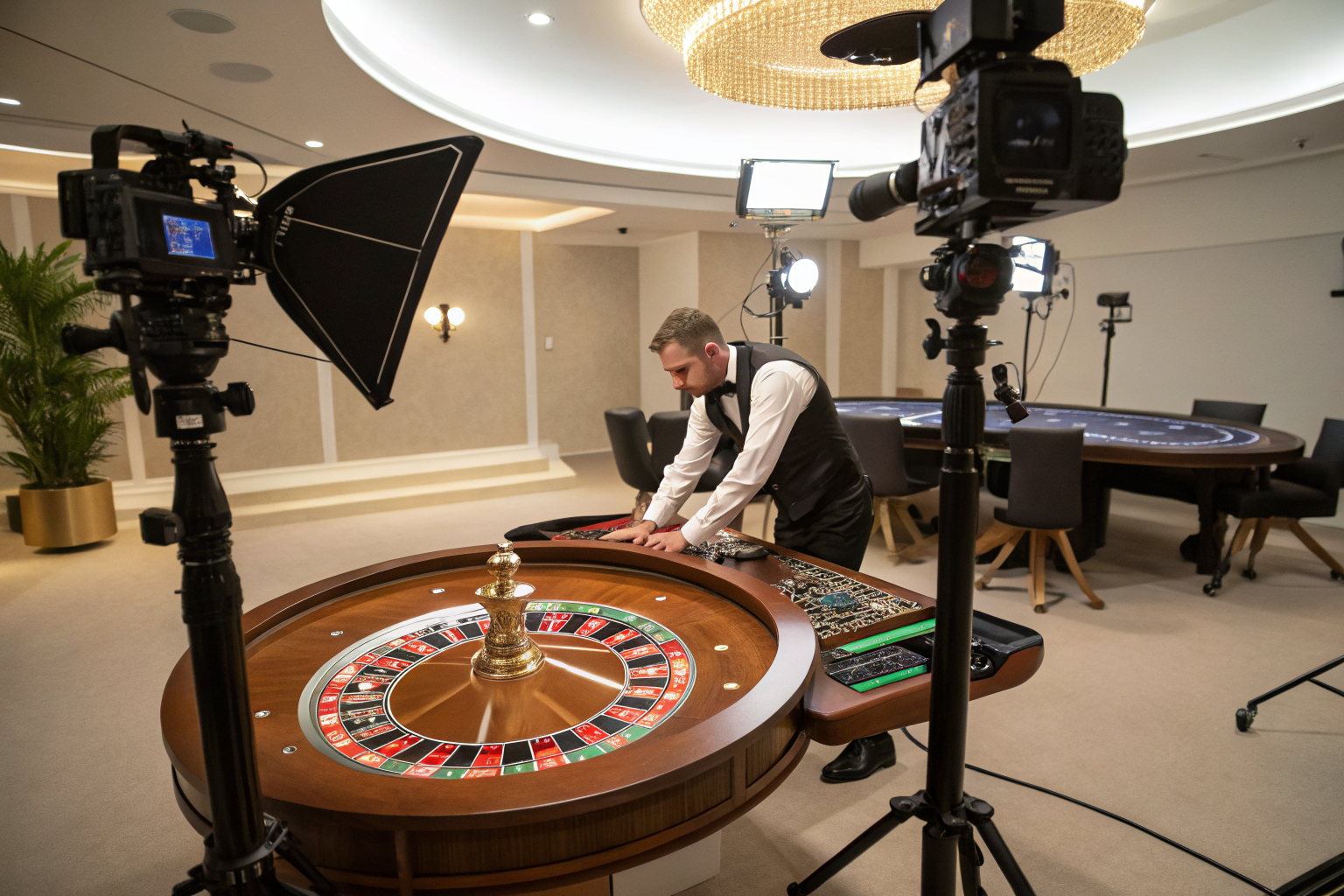
Live dealer roulette in US online casinos represents a sophisticated blend of traditional gaming and cutting-edge streaming technology. Unlike standard RNG-based roulette, live dealer variants feature real croupiers operating physical roulette wheels in professional studios, with every spin streamed in real-time to players across regulated states like New Jersey, Pennsylvania, Michigan, Connecticut, and West Virginia.
While most gambling content focuses on bonuses, table limits, and legal availability, the technical infrastructure behind these streams directly impacts your gaming experience. Stream quality, latency issues, and camera positioning affect everything from bet timing accuracy to your ability to trust the outcomes you’re watching. Understanding these technical factors helps you make informed choices about which tables to join and how to optimize your setup for the best possible live roulette experience.
What Is Live Dealer Roulette in US Online Casinos?
Live dealer roulette combines the convenience of online gaming with the authentic atmosphere of land-based casinos through real-time video streaming technology. Professional dealers operate physical roulette wheels in specialized studios, while players place digital bets through intuitive interfaces that synchronize with the live action. This hybrid approach maintains the unpredictability of physical wheel mechanics while offering the accessibility of online play.
The technology is exclusively available in states with regulated online gambling frameworks, where licensing authorities ensure fair play and technical standards. Each live roulette session involves multiple HD cameras, professional lighting setups, and low-latency streaming infrastructure designed to deliver seamless real-time gameplay.
Key features that distinguish live dealer roulette from both RNG alternatives and simple casino floor streams include sophisticated multi-angle camera coverage, dealer voice announcements synchronized with betting windows, and adaptive streaming technology that adjusts quality based on your connection speed. The experience bridges the gap between solitary digital gaming and communal casino floor atmosphere.
- HD video streaming with multiple camera angles showing wheel, ball, and dealer actions
- Real-time dealer announcements and interaction through live chat functionality
- Synchronized betting windows that close precisely when dealers call “no more bets”
- Adaptive streaming quality that adjusts to network conditions automatically
- Professional studio lighting and audio designed for optimal clarity
- Integration with digital betting interfaces that track your wagers and balance
Studio vs Land‑Based Live Roulette Feeds
Purpose-built live casino studios offer significant advantages over direct casino floor streaming in terms of technical performance and player experience. Studio environments eliminate ambient noise, crowd interference, and variable lighting conditions that can compromise stream quality. The controlled setting allows for optimal camera positioning, professional-grade audio equipment, and consistent dealer presentation.
Latency typically runs lower in studio setups since the infrastructure is designed specifically for streaming rather than adapted from existing casino operations. Studios also maintain backup systems and redundant connections that reduce the likelihood of interruptions during gameplay.
However, some players prefer the authentic casino atmosphere that land-based feeds provide, including background sounds of slot machines and the general buzz of casino activity. The trade-off usually comes down to technical reliability versus atmospheric immersion, with most US operators favoring studio setups for their superior consistency.
US Regulation, Licensing, and Player Protections
Live dealer roulette operations in the US must comply with strict licensing requirements that extend beyond traditional online casino regulations to include streaming technology standards. State gaming commissions require regular audits of both the gaming equipment and the technical infrastructure, ensuring that video feeds cannot be manipulated and that latency doesn’t create unfair advantages.
Player protection measures include mandatory recording of all gaming sessions, real-time monitoring for technical irregularities, and specific requirements for bet settlement timing that account for network delays. Licensed operators must also provide technical support specifically trained to handle streaming-related issues.
The regulatory framework requires transparent disclosure of average latency times, minimum bandwidth requirements, and compatibility standards, giving players the information needed to assess whether their setup can handle live dealer gameplay effectively.
How Live Dealer Roulette Streams Work Behind the Scenes
The technical architecture supporting live dealer roulette involves multiple HD cameras positioned at strategic angles around each table, connected to professional-grade video encoders that compress and optimize the footage for internet transmission. High-performance servers handle the simultaneous processing of video feeds, audio streams, and betting data while maintaining synchronization between all elements.
Real-time computing systems track dealer actions, monitor wheel physics, and coordinate betting window timing with millisecond precision. Advanced optical character recognition technology can verify ball positions and automatically detect winning numbers, though human dealers typically make the final announcements to maintain the personal touch that distinguishes live play from automated alternatives.
Video compression algorithms use adaptive bitrate streaming to balance visual quality with available bandwidth, automatically adjusting resolution and frame rates based on network conditions. This ensures consistent playback across different devices and connection speeds while maintaining the visual clarity needed to follow ball movement and read betting layouts.
The integration of betting interfaces requires sophisticated backend systems that process wager data, update account balances, and calculate payouts in real-time while maintaining perfect synchronization with the live video stream. Any delay or desynchronization between these elements can undermine player trust and create technical disputes.
From Studio to Screen: The Live Roulette Data Flow
Understanding the technical journey from studio camera to your screen helps explain why certain delays occur and what factors influence overall stream quality. Each step in the process adds potential latency while serving essential functions for gameplay integrity and visual quality.
The complexity of this data flow explains why live dealer roulette requires more robust internet connections than standard online games and why technical issues can occasionally interrupt gameplay despite sophisticated backup systems.
- Multiple HD cameras capture different angles of the roulette table simultaneously at 30-60 frames per second
- Video encoders compress and optimize footage while audio processors handle dealer microphones and ambient sound
- Streaming servers combine video, audio, and betting interface data into synchronized data packages
- Content delivery networks distribute streams to regional servers for reduced latency to end users
- Your device receives and decodes the stream while maintaining synchronization with betting windows
- Interactive elements like chat and betting controls communicate back to studio systems in real-time
Stream Quality in Live Dealer Roulette: Resolution, Bitrate, and Frame Rate
Stream quality in live dealer roulette depends on several technical metrics that directly impact your ability to follow gameplay and make informed betting decisions. Resolution determines the sharpness of visual details like ball position and number readability, while bitrate affects how smoothly motion appears during wheel spins. Frame rate influences the fluidity of dealer movements and ball tracking.
Audio quality plays an equally important role, as clear dealer announcements help confirm betting windows and results even when visual elements might be temporarily unclear due to network conditions. Professional live roulette setups typically use dedicated audio processing to ensure voice clarity while filtering out mechanical noise from wheel operation.
The challenge for operators lies in balancing high-quality streams with broad accessibility, since not all players have the bandwidth to support full HD streaming consistently. Adaptive streaming technology helps address this by automatically adjusting quality parameters based on real-time network performance.
| Quality Metric | Typical Values in US Live Roulette | Impact on Player Experience | What to Look For |
|---|---|---|---|
| Resolution | 720p-1080p HD, some 4K | Affects number visibility and ball tracking clarity | Sharp text on betting layout, clear wheel numbers |
| Bitrate | 2-8 Mbps depending on quality | Determines smoothness during wheel movement | No pixelation during fast ball spins |
| Frame Rate | 25-60 FPS | Influences ball tracking and motion fluidity | Smooth dealer gestures, no choppy movement |
| Audio Clarity | 48-96 kHz sampling rate | Essential for hearing bet calls and results | Clear dealer voice without background noise |
| Latency | 2-10 seconds typical delay | Affects betting timing and perceived fairness | Consistent delay without sudden jumps |
How Compression and Network Conditions Affect Roulette Streams
Video compression artifacts become particularly noticeable during the high-motion moments that define roulette gameplay, such as ball spins and dealer hand movements. Aggressive compression can cause pixelation or blurring precisely when visual clarity matters most for tracking outcomes. Network jitter and packet loss create stuttering effects that can make it difficult to follow ball trajectory or read final positions.
Player-side solutions include ensuring stable broadband connections with consistent upload speeds for interactive features, closing bandwidth-intensive applications during gameplay, and using wired connections when possible to reduce wireless interference. Many experienced players test their connection stability using speed test tools before joining high-stakes tables.
Modern adaptive streaming helps mitigate these issues by detecting network problems and automatically reducing quality rather than allowing complete interruptions, but the trade-off means temporarily reduced visual clarity during critical moments of gameplay.
Mobile vs Desktop Streaming Quality
The choice between mobile and desktop devices for live dealer roulette involves several technical trade-offs that affect stream quality and overall gaming experience. Screen size limitations on mobile devices can make it harder to read betting layouts and track ball movement, while the smaller displays may not fully utilize available video resolution.
Network connectivity often differs significantly between platforms, with mobile devices relying on potentially variable Wi-Fi signals or cellular data that may have bandwidth limitations or data caps. Desktop connections typically offer more stable and higher-bandwidth options, supporting consistently higher stream quality.
- Desktop advantages: larger screens show more detail, wired connections reduce latency, better multitasking for tracking multiple tables
- Mobile benefits: flexibility to play anywhere, touch interfaces can feel more intuitive for betting, optimized apps may handle network switching better
- Desktop challenges: less portable, may require dedicated gaming time and space
- Mobile limitations: smaller screens reduce visual detail, cellular data costs and speed variability, battery drain during extended sessions
Latency in Live Dealer Roulette: What Delay Really Means for Players
Latency in live dealer roulette refers to the time delay between real-world events in the studio and their appearance on your screen, typically ranging from 2-10 seconds depending on technical infrastructure and your internet connection. This delay exists because video must be captured, processed, compressed, transmitted, and decoded before reaching your device, with each step adding milliseconds to the total lag time.
The practical impact of latency extends beyond mere technical inconvenience to affect fundamental aspects of gameplay timing and psychological comfort. Players often struggle with the perception that they’re watching “old” footage, particularly when betting windows close based on real-time studio events rather than what appears on their delayed stream. Understanding this delay helps set appropriate expectations and prevents frustration with seemingly unfair bet cutoff timing.
Professional live casino operations invest heavily in low-latency streaming infrastructure, including dedicated servers, optimized encoding algorithms, and strategic content delivery network placement to minimize delays. However, player-side factors like internet connection quality, device processing power, and geographic distance from streaming servers continue to influence individual latency experiences.
Advanced operators provide latency indicators or connection quality metrics within their interfaces, helping players understand their specific delay characteristics and adjust their betting strategies accordingly. Some systems even allow slight timing adjustments to account for individual latency patterns, though this requires sophisticated calibration to maintain fairness across all participants.
The psychological aspect of latency often proves more challenging than the technical reality, as players must develop comfort with the concept that their view of events is slightly behind real-time while maintaining confidence in the fairness and integrity of the gaming process.
How Latency Impacts Betting Windows and Player Decisions
Effective latency management becomes crucial for successful live roulette participation, requiring players to develop strategies that account for the inherent delay in streaming technology. Understanding your specific latency characteristics helps avoid the frustration of late bets that appear valid on your screen but arrive after the studio’s betting window has closed.
Smart betting approaches acknowledge the reality of streaming delays while maximizing your ability to make informed decisions based on available information. These techniques become particularly important during busy gaming sessions or when playing multiple tables simultaneously.
- Test your connection latency during low-stakes play before committing to higher table limits
- Place bets early in each betting window rather than waiting for the last possible moment
- Use strong, stable internet connections and avoid peak usage times when possible
- Close unnecessary applications and browser tabs that might consume bandwidth during gameplay
- Consider wired ethernet connections over Wi-Fi for the most consistent latency performance
Camera Setup and Angles in Live Roulette Studios
Professional live roulette studios employ sophisticated multi-camera systems designed to provide comprehensive coverage of all gaming elements while building player trust through transparency. The typical setup includes overhead wheel cameras for clear ball tracking, wide table shots showing the full betting layout, and dealer close-ups that capture hand movements and facial expressions. Advanced studios may use six or more synchronized cameras to eliminate blind spots and provide multiple viewing perspectives.
Camera switching typically occurs automatically based on game phases, with overhead angles dominating during spins for optimal ball tracking, then switching to wide shots for result confirmation and payout calculations. Some operators allow players to manually select preferred camera angles, providing customization options that cater to individual viewing preferences and screen sizes.
The technical challenge lies in maintaining consistent lighting, color balance, and focus across all cameras while ensuring that automated switching doesn’t create jarring transitions that disrupt the gaming experience. Professional-grade equipment includes stabilization systems, automated focus tracking, and color correction technology that maintains visual consistency regardless of which camera feed is active.
| Camera Angle | Typical Placement | Used For | Pros for Players | Potential Drawbacks |
|---|---|---|---|---|
| Overhead Wheel | Directly above roulette wheel | Ball tracking and result verification | Clear view of winning number, eliminates doubt | Limited context, can’t see dealer actions |
| Dealer Close-Up | Focused on dealer’s upper body | Hand movements and announcements | Personal connection, clear audio | Can’t see wheel or betting area |
| Wide Table Shot | Captures entire gaming area | Overall game context and layout | Complete perspective, good for strategy | Details may be hard to see |
| Side Wheel View | Angled view of wheel profile | Ball release and spinning motion | Shows wheel mechanics, dramatic visuals | Final result may be unclear |
| Betting Layout | Above the felt betting area | Chip placement and payouts | Clear view of bet types and odds | Static view, limited action |
Fixed Rigs vs Robotic and PTZ Cameras
Traditional fixed camera rigs offer reliability and consistent image quality but limit the dynamic visual experience that can enhance player engagement. These setups use multiple static cameras positioned at predetermined angles, with switching handled by production software rather than physical camera movement.
Advanced studios increasingly employ pan-tilt-zoom (PTZ) cameras and robotic systems that can automatically adjust positioning, focus, and framing based on game phases. These systems enable more cinematic presentations with smooth tracking movements that follow ball trajectories or zoom in on winning numbers for dramatic effect.
The trade-off involves complexity and potential mechanical failure points versus enhanced visual storytelling and the ability to adapt camera work to specific game moments. Premium live roulette offerings often feature hybrid approaches that combine reliable fixed cameras with selective robotic elements for enhanced presentation quality.
Designing Camera Layouts for Clarity and Trust
Effective camera layout design prioritizes transparency and player confidence by ensuring that no critical game elements remain hidden from view during any phase of play. This requires careful consideration of blind spots, reflection issues from studio lighting, and the need for redundant coverage of essential areas like the wheel and betting layout.
Trust-building camera strategies include providing alternative angle options during disputed outcomes, maintaining consistent coverage during dealer chip handling, and ensuring that ball release and landing are visible from multiple perspectives simultaneously. Professional layouts also account for the technical reality that players may be watching on various device sizes and screen orientations.
The psychological impact of camera design extends beyond mere technical coverage to influence player comfort levels and perceived fairness, making thoughtful layout planning essential for successful live dealer operations that build lasting player relationships.
Comparing Live Dealer Roulette Streams Across US Operators
Live dealer roulette streaming quality varies significantly across US operators, reflecting differences in technology investment, provider partnerships, and target player demographics. Premium operators typically offer higher resolution streams, lower latency connections, and more sophisticated camera setups, while budget-focused platforms may prioritize accessibility and lower bandwidth requirements over cutting-edge visual quality.
Regional licensing patterns also influence streaming capabilities, as operators serving multiple states must balance technical performance with regulatory compliance across different jurisdictions. Some states have specific requirements for streaming quality or latency that affect how operators design their technical infrastructure.
The competitive landscape drives continuous improvements in streaming technology, with operators regularly upgrading their systems to maintain player satisfaction and attract new customers who expect high-quality live gaming experiences comparable to premium entertainment streaming services.
| Operator / Brand (Example) | Typical Stream Resolution | Latency Experience (Typical) | Notable Camera Features | States Available (Example) |
|---|---|---|---|---|
| Premium Multi-State Operator | 1080p HD, some 4K tables | 2-4 seconds typical | Multiple angle selection, automated switching | NJ, PA, MI, CT |
| Regional Focus Platform | 720p-1080p adaptive | 3-6 seconds average | Standard multi-camera, good stability | PA, WV |
| Budget-Friendly Option | 720p standard | 4-8 seconds typical | Basic angles, reliable quality | NJ, MI |
| Technology-Forward Brand | 4K select tables, 1080p standard | 2-3 seconds optimized | Cinematic presentation, dynamic angles | NJ, PA, MI |
| Mobile-Optimized Service | Adaptive 480p-1080p | 3-5 seconds variable | Portrait-friendly layouts, touch optimization | NJ, PA, CT |
How Review Sites Evaluate Live Roulette Stream Quality
Professional gambling review platforms use standardized testing methodologies to assess live dealer roulette streaming quality across different operators and technical conditions. These evaluations typically involve testing from multiple devices, connection speeds, and geographic locations to provide comprehensive coverage of real-world performance variations.
The evaluation process often includes both technical measurements using specialized software and subjective assessments from experienced players who can identify subtle quality differences that affect the gaming experience. Review sites may also conduct extended testing sessions to identify performance consistency over time and under varying network loads.
- Stream resolution consistency across different devices and connection speeds
- Load time from table selection to playable stream initiation
- Dealer professionalism, audio clarity, and interaction quality
- Technical stability during extended play sessions and peak usage periods
- Camera angle effectiveness for gameplay clarity and outcome verification
- Integration quality between video stream and betting interface responsiveness
Live Roulette Variants in the US and Their Streaming Implications
Different roulette variants available in US live dealer formats each present unique streaming challenges and opportunities that affect technical implementation and player experience. American roulette with its double-zero wheel requires specific camera angles to clearly distinguish between the 0 and 00 pockets, while European single-zero variants can utilize more straightforward overhead positioning for result verification.
Specialty variants like Lightning Roulette, Speed Roulette, and Auto Roulette each demand customized streaming approaches to accommodate their unique visual elements and timing requirements. These games often feature additional graphics overlays, enhanced lighting effects, or accelerated gameplay that requires higher processing power and more sophisticated streaming infrastructure.
- American Roulette: requires clear differentiation of 0 and 00 pockets through precise camera positioning
- European Roulette: benefits from simpler wheel layout allowing for more flexible camera angles
- Speed Roulette: demands ultra-low latency streaming to accommodate rapid betting windows
- Auto Roulette: features automated ball release requiring specialized cameras to track mechanical systems
- Lightning Roulette: incorporates digital effects overlays that increase bandwidth and processing requirements
- Immersive Roulette: uses multiple camera angles with cinematic switching requiring higher-end streaming infrastructure
- VIP Roulette: often features premium studio setups with enhanced lighting and audio systems
American vs European Live Roulette: Visual and UX Differences
The fundamental wheel design differences between American and European roulette create distinct visual requirements for live streaming setups. American wheels with 38 pockets including both 0 and 00 require camera positioning that clearly differentiates between these similar-looking green pockets, often necessitating additional close-up angles or higher resolution streams to ensure result clarity.
European roulette’s single-zero layout allows for more streamlined camera work and can often achieve the same level of clarity with lower bandwidth requirements. The betting layout differences also affect how much screen real estate is needed to display all available betting options clearly, influencing mobile optimization strategies.
Player preference surveys often show that the visual clarity advantages of European roulette streaming contribute to its popularity beyond just the improved odds, as players report higher confidence in result verification and easier ball tracking during play.
Speed and Auto Roulette: When Latency Feels Different
Speed Roulette and Auto Roulette variants compress traditional roulette timing into much shorter cycles, making latency issues more pronounced and potentially more frustrating for players. The reduced betting windows in Speed Roulette mean that even normal 3-4 second streaming delays can eliminate significant portions of the decision-making time players expect.
Auto Roulette systems with mechanical ball release mechanisms require specialized camera setups to capture the automated systems in action, building player trust in the mechanical randomness while maintaining visual clarity of the automated processes. The lack of human dealer interaction shifts more emphasis to visual stream quality for maintaining player engagement.
These rapid-play formats often attract players specifically seeking faster action, making streaming performance issues more likely to drive immediate table abandonment compared to standard-pace games where players may tolerate occasional technical hiccups.
Player‑Side Tech: Devices, Connections, and Settings That Affect Your Stream
Your personal technology setup plays a crucial role in live dealer roulette streaming quality, often having more impact on your experience than the casino’s infrastructure. Older devices may struggle with HD video decoding, causing dropped frames or stuttering during crucial moments like ball spins. Internet connection stability matters more than raw speed, as consistent bandwidth prevents the buffering and quality drops that can interrupt gameplay flow.
Device-specific optimizations can significantly improve streaming performance, from closing unnecessary applications that consume processing power to adjusting display settings that reduce strain on your graphics hardware. Mobile players face additional challenges with battery life management and data usage considerations that desktop users don’t encounter.
Network environment factors often overlooked by casual players can dramatically impact streaming quality, including Wi-Fi signal strength, router placement, and competing bandwidth usage from other household devices or applications running in the background.
- Ensure your device meets recommended specifications for HD video streaming and has adequate free storage
- Use wired ethernet connections when possible, or position yourself close to your Wi-Fi router for strongest signal
- Close bandwidth-intensive applications like video streaming, file downloads, or cloud backup services during gameplay
- Update your browser or casino app to the latest version to access performance improvements and bug fixes
- Test your internet connection speed and stability using online tools before joining higher-stakes tables
- Consider using quality-of-service (QoS) settings on your router to prioritize gaming traffic during play sessions
- Monitor your data usage if playing on mobile to avoid throttling or unexpected charges from cellular providers
Troubleshooting Common Live Roulette Streaming Issues
Most live roulette streaming problems stem from predictable technical issues that players can resolve independently through systematic troubleshooting approaches. Connection-related problems account for the majority of streaming interruptions, followed by device performance issues and software compatibility conflicts that develop over time.
Licensed US operators typically provide dedicated technical support teams trained specifically in live dealer streaming issues, offering both real-time assistance during gameplay and follow-up troubleshooting for recurring problems. These support resources often include device-specific guidance and connection optimization recommendations tailored to your particular setup.
Proactive problem prevention proves more effective than reactive troubleshooting, with experienced players developing routine check processes they perform before each gaming session to identify and address potential issues before they affect gameplay.
Practical Checklist: Evaluating a Live Dealer Roulette Table Before You Sit
Smart table selection begins with a systematic evaluation of streaming quality and technical performance before committing to gameplay, particularly important when considering higher table limits or extended gaming sessions. Visual indicators in the lobby preview can reveal potential streaming issues, while simple load time measurements help predict ongoing performance stability.
Professional players often develop personalized checklists that account for their specific device capabilities, connection characteristics, and gameplay preferences. These evaluation routines become particularly valuable when exploring new operators or testing unfamiliar roulette variants that may have different technical requirements.
| Aspect to Check | What to Observe in the Lobby/Table Preview | Ideal Signs | Warning Signs |
|---|---|---|---|
| Stream Load Time | Time from table click to live video display | Under 5 seconds to clear video | Extended loading, multiple connection attempts |
| Visual Clarity | Sharpness of wheel numbers and betting layout | Crisp text, clear number visibility | Blurry numbers, pixelated graphics |
| Audio Quality | Dealer voice clarity and background noise | Clear speech, minimal background noise | Muffled audio, echo, or static |
| Motion Smoothness | Dealer movements and ball tracking fluidity | Smooth gestures, clear ball movement | Choppy motion, stuttering during spins |
| Interface Responsiveness | Betting button reaction time and accuracy | Immediate response to taps/clicks | Delayed responses, missed inputs |
| Camera Angles | Available viewing options and switching quality | Multiple clear angles, smooth transitions | Limited views, jarring camera switches |
| Connection Stability | Consistency of stream quality over time | Stable quality without fluctuation | Quality drops, buffering symbols, disconnections |
Testing Stream Quality in the First Few Spins
Initial gameplay observation provides valuable insights into streaming performance under actual gaming conditions, revealing issues that may not be apparent during lobby preview. Smart players use early spins to evaluate technical performance while making minimal financial commitments, treating the first few rounds as a technical evaluation period rather than serious gaming attempts.
Systematic testing approaches help identify performance patterns and potential issues before they affect higher-stakes gameplay, allowing players to make informed decisions about whether to continue at a particular table or seek alternatives with better technical performance.
- Place minimum bets for the first 2-3 spins while focusing on stream quality assessment
- Test betting interface responsiveness by placing and modifying wagers during different betting window phases
- Monitor audio-video synchronization by watching for delays between dealer speech and visible actions
- Observe stream stability during high-motion moments like ball spins and dealer chip handling
- Check camera angle switching functionality if multiple viewing options are available
Balancing Stream Quality With Table Limits and Game Features
The relationship between streaming quality and table characteristics often involves trade-offs that require careful consideration based on your gaming priorities and budget constraints. Premium tables with higher betting limits typically offer superior streaming infrastructure, but the improved technical experience may not justify the increased financial exposure for all players.
Feature-rich game variants with enhanced visuals, multiple camera angles, and interactive elements generally demand more bandwidth and processing power, potentially creating performance challenges for players with older devices or limited internet connections. Understanding these technical requirements helps in making informed table selection decisions.
Successful players develop strategies that balance their desired gaming experience with their technical capabilities and financial comfort levels, recognizing that the most technically impressive table isn’t always the most suitable choice for their specific circumstances and goals.
Future Trends in US Live Roulette Streaming Technology
The evolution of live dealer roulette streaming technology continues to accelerate, driven by advances in video compression, 5G networking, and cloud computing infrastructure that promise to address current limitations while enabling new gaming experiences. Ultra-low latency streaming protocols under development could reduce delays to under one second, fundamentally changing the timing dynamics of live dealer gameplay.
Emerging technologies like 8K resolution streaming and advanced HDR color processing will provide unprecedented visual clarity, while AI-powered automatic camera direction could create more dynamic and personalized viewing experiences tailored to individual player preferences and betting patterns. However, these advances must balance technical sophistication with broad accessibility across diverse player device capabilities and internet connection qualities.
Virtual reality integration represents a longer-term possibility that could transform live dealer roulette from a screen-based experience into an immersive environment where players feel physically present at the gaming table. Augmented reality overlays might provide additional statistical information, betting guidance, or customizable interface elements without requiring specialized hardware.
The regulatory landscape will continue to influence technological adoption, as state gaming authorities develop new standards for emerging streaming technologies while maintaining their focus on fair play, player protection, and technical reliability that defines the current regulated environment.
What Players Should Expect in the Next Few Years
Near-term improvements in live dealer roulette streaming will likely focus on addressing current pain points rather than revolutionary changes, with enhanced stability, reduced latency, and broader device compatibility taking priority over cutting-edge features that may not be accessible to all players.
The competitive pressure among US operators will drive continuous incremental improvements in streaming quality, customer support, and technical reliability as the market matures and players develop higher expectations based on their experiences across different platforms.
- Consistent HD streaming availability across all major operators with improved compression efficiency
- Reduced average latency through infrastructure improvements and optimized content delivery networks
- Enhanced mobile experiences with better touch interfaces and battery life management
- Improved integration between streaming video and betting interfaces for smoother gameplay
- Advanced troubleshooting tools and automated performance optimization features
Key Takeaways: Stream Quality, Latency, and Cameras in US Live Roulette
Understanding the technical infrastructure behind live dealer roulette empowers players to make informed decisions about table selection, device optimization, and realistic performance expectations. The interplay between streaming quality, latency characteristics, and camera setup directly affects your gaming experience in ways that extend far beyond simple visual appeal to influence betting timing, outcome trust, and overall satisfaction.
The regulated US market provides baseline quality assurance and player protections that distinguish licensed operators from unregulated alternatives, but significant variation still exists in streaming performance, technical capabilities, and user experience quality among legitimate platforms. Smart players leverage this technical knowledge to identify operators and tables that match their specific device capabilities, connection characteristics, and gameplay preferences.
Success in live dealer roulette increasingly depends on technical preparation and understanding, from optimizing your personal setup to recognizing quality indicators that predict reliable performance throughout extended gaming sessions.
- Streaming technology directly impacts gameplay through visual clarity, betting timing accuracy, and outcome verification confidence
- Player-side technical preparation often has more impact on experience quality than casino infrastructure differences
- Systematic table evaluation before committing to gameplay prevents technical frustrations and financial losses from poor-quality streams
- Regulated US markets provide quality baselines and player protections but still require informed selection among varying technical capabilities
- Future improvements will focus on solving current limitations like latency and accessibility rather than revolutionary new features
- Understanding camera setups and streaming workflows helps players identify trustworthy operations and recognize potential technical issues
- Mobile and desktop platforms each offer distinct advantages that should influence device choice based on individual gaming priorities
Turning Technical Knowledge Into Better Table Choices
The investment in understanding live dealer roulette streaming technology pays dividends through improved table selection, reduced technical frustrations, and enhanced confidence in the fairness and reliability of your gaming experience. Players who approach live dealer roulette with technical awareness consistently report higher satisfaction and fewer problems compared to those who focus solely on game rules and betting strategies.
This technical foundation becomes increasingly valuable as the US live dealer market expands and diversifies, providing the knowledge base needed to evaluate new operators, game variants, and technological innovations as they become available in your state’s regulated market.
Most importantly, understanding the technology behind the experience helps distinguish between technical limitations that affect all players equally and genuine quality differences that should influence your choice of gaming platforms and table selection strategies.